
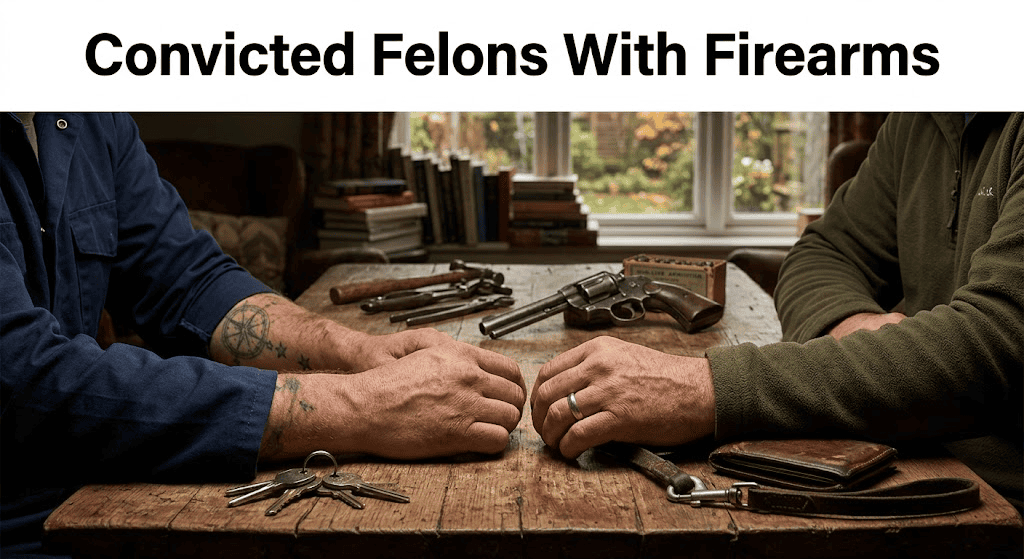
Convicted Felons with Firearms in the United States by Wayne T. Dowdy
Convicted felons with firearms in the United States! So what?
Not everyone convicted of breaking the law poses a threat to the security of this country or to its citizens — and that does not change because the person has a firearm. A lifetime ban makes no distinction between a violent predator and a man whose felony is decades behind him and who has lived clean ever since.
That is not justice, and it is not safety!
Here is what a blanket ban really does: the only people who obey it are the ones who obey the law anyway. Those who mean harm pay it no mind. A lawful path back — one that demands fingerprints, court records, and proof that a person is not likely to endanger public safety — brings people back inside the law instead of leaving them outside it. That is how restoring rights the right way can help make America safer: it opens the door to those who have proven they have changed, and it keeps the door shut to those who have not.
Individuals
For the first time in decades, there is a real process. The U.S. Department of Justice now accepts applications for Federal Firearms Rights Restoration (FFRR) under 18 U.S.C. § 925(c), reviewed through the Office of the Pardon Attorney.
A Door Is Opening: Federal Firearms Rights Restoration!
The program opened to invited applicants on September 25, 2026. It opens to the public on November 4, 2026 — the first 5,000 applicants — with more openings to follow, including another round on January 4, 2027. Restoration is neither automatic nor guaranteed. Each application receives an individual review, and the Department must be satisfied that the applicant is not likely to act in a manner dangerous to public safety and that granting relief is not contrary to the public interest. Depending on the conviction, a waiting period of five or ten years after the sentence is completed may apply before a person can be considered.
Who Can Apply
If you are an individual federally prohibited from possessing, or otherwise handling, firearms for one or more of the following reasons, pursuant to 18 U.S.C. § 922(g), then you are eligible to apply for Federal Firearms Rights Restoration (FFRR):
• Felons — 18 U.S.C. § 922(g)(1)
• Fugitives — 18 U.S.C. § 922(g)(2)
• Unlawful drug users — 18 U.S.C. § 922(g)(3)
• Certain mental health statuses — 18 U.S.C. § 922(g)(4)
• Certain aliens — 18 U.S.C. § 922(g)(5)
• Dishonorable discharge — 18 U.S.C. § 922(g)(6)
• Citizenship renunciants — 18 U.S.C. § 922(g)(7)
• Domestic violence court order — 18 U.S.C. § 922(g)(8)
• Domestic violence misdemeanants — 18 U.S.C. § 922(g)(9)
Please support this website by donating any amount to the Fund Raiser on PayPal by clicking Here or by purchasing Books by Wayne T. Dowdy. Thank you!
Enterprises
Businesses and Organizations
If you are a corporation or entity that has lost its federal firearms rights, the Department will process those requests separately from the process for individual applicants. Check the Department’s website for more information as it becomes available.
State or Tribal firearm rights
What It Does Not Do
The FFRR application process does not automatically restore state or tribal firearm rights. Federal relief removes the federal disability only. Check with your local authorities for more information about state or tribal rights.
Learn More and Apply
For more information on who can apply and the application process, visit the U.S. Department of Justice: Who Can Apply for Federal Firearm Rights Restoration (justice.gov/ffrr).
Credits
Written by Wayne T. Dowdy, Straight From The Pen (straightfromthepen.com). © 2026 Wayne T. Dowdy. Eligibility information from the U.S. Department of Justice, Federal Firearms Rights Restoration (justice.gov/ffrr).